
-
Welcome to N-cars.net - the largest Hyundai N car forum. Check out the model specific sections below and scroll down for country specific forums. Scroll down for i30 N, Ioniq 5 N, i20 N, Veloster N and Kona N forums! Check out the i30 N Bible Here!
Tuning i20N Engine & ECU Tuning Discussion
- Thread starter POLNGU
- Start date
You are using an out of date browser. It may not display this or other websites correctly.
You should upgrade or use an alternative browser.
You should upgrade or use an alternative browser.


I've had personal contact with them myself, they have worked WITH Tristan in the past and likely continue to do so but the custom patching developed by the guys over at Cherry tuning although beneficial to safety controls and top end power produced a relatively laggy feel out of the turbo in the low end.Who says they arent patching it like Cherry?
As far as i can tell from reading that, they could have separately reproduced what Cherry did, or they could have just got it from Cherry. I highly doubt they found a new novel way of unlocking boost control. It's just your average marketing post that skips over the important details, so they can keep their cards close to their chest.
Follow up post...
They did, but without some evidence, like dyno results, its just marketing puff.
Ahh okay, Their website has a graph for a "stage 3" build, only compressor wheel upgrade:Thanks for that, but isn’t this similar to what BF were achieving before? I was thinking more along the lines of dyno runs of their 300+ and multi-stage turbo claims.

Slightly more power across the rev range by comparison which is a bonus to the added safety. Of course we'll wait and see what a larger exhaust turbine wheel on a bigger turbo produces on the dyno but judging by yours being at 298 and others from the CS guys being ~290-300, I can only assume this will garner a similar result with a larger turbine wheel to flow more exhaust air in the top end and not being throttled by back pressure from the small standard turbine wheel.
as for stage 2, you can see the difference even the MAP fooling strategy made on my car:
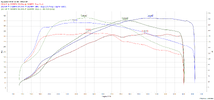
that ugly dip in the graph at 4500 rpm is all but eliminated.
The real work here isn't so much "added power" (although that may be a bi-product) it's better to define this as a much safer tuning strategy that allows the ECU full visibility over what the boost is doing rather than behaving almost like a tuning box and messing with the scaling of the MAP sensor

But isnt Cherry also safer and gives full visibility? This is BF comparing tune safety to previous BF, not Cherry.it's better to define this as a much safer tuning strategy that allows the ECU full visibility over what the boost is doing rather than behaving almost like a tuning box and messing with the scaling of the MAP sensor
The thing i am getting from this is that they arent doing what Cherry is doing, so is this a discussion about how this is better/different or just drumming up business in the UK to get people to pay for another tune?
I havent tuned yet as i'm far from using the cars potential for now, but i get my servicing done at Cherry and i'd like to think their tune will be good and safe without tricking the boost numbers. I'm still struggling to understand what BF has done thats going to work with the ECUs constant safety calculations...
The fact is, I can't get a BF tune, and you guys cant get a Cherry tune, so i just want to understand the methods generally, based on what they share until the point they can't reveal any more secrets.
Last edited:
Source on this please.the guys over at Cherry tuning although beneficial to safety controls and top end power produced a relatively laggy feel out of the turbo in the low end.
I can't determine if this is trustworthy. Tristan at BF? Others? Very few people would have access to both tunes to compare them. Working/Speaking with these guys is great, and I have also personally spoken to Cherry, but I'm no expert, so i will generally indicate my experience/provenance so that people can apply appropriate weight to what i say.
Being told something is safe, without being given details on what makes it safe, it something i can't help but push back on as marketing spin. It might well be safe, but a FB post needs a bit more to put my mind to rest.
The old methods obviously adjusted the boost numbers. Its visible in their dash display. I'd love to see them showing an i20N dash showing a higher boost number in the dash.
Last edited:
The major difference between these 2 is just the method of getting the car to boost, the Cherry stuff is all custom code whereas BF just use the factory ECU software and alter that instead. These 2 methods comparatively are pretty much the same safety wise, the ECU can see exactly how much boost the turbo is making, what is being requested and comparing that to it's safety parameters.I havent tuned yet as i'm far from using the cars potential for now, but i get my servicing done at Cherry and i'd like to think their tune will be good and safe without tricking the boost numbers. I'm still struggling to understand what BF has done thats going to work with the ECUs constant safety calculations...
The fact is, I can't get a BF tune, and you guys cant get a Cherry tune, so i just want to understand the methods generally, based on what they share until the point they can't reveal any more secrets.
The other tuners worldwide that are yet to implement either custom code or have the factory software worked out are likely using the MAP sensor fooling method or the car doesn't make linear power after 5k RPM. the "not so safe" part of this is just that the ECU is seeing altered values so it thinks the car is making it's standard 1.1-1.3 bar max boost and let's the turbo keep working but what you're actually seeing here is 1.6-1.7 bar peak boost with the sensor being rescaled and there's room for it to overboost when it's not enforcing safety parameters properly.
Basically between Cherry and the BF methods, the safety is practically the same, the ECU knows exactly what's going on and is enforcing parameters as it's supposed to, there's just a bit more work involved with patching in custom code.
To address your other post just below, You can see the difference spool wise in the 2 methods through dyno graphs and you can see where the torque comes in:
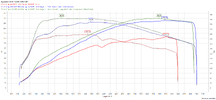
With the BF stuff, you can see torque is already peaking at around 2000 RPM, very fast onset with full throttle starting at 1400 RPM and having full torque within 600 RPM. Now obviously that's with a slightly larger compressor wheel which impacts spool time here too but even on the stage 2 builds you can see that flat peak torque is still reached by 2200 RPM after starting the pull at 1200 RPM where in the higher gears that you'd use on the dyno, you get major turbo lag until about 1800 RPM, you can see that lag in the graph too at the start where it starts to respond as the graph takes a sharper turn up in torque around 1600 RPM:
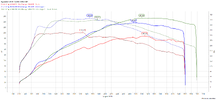
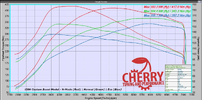
Slightly different looking dyno graphs but you can see a slightly slower onset of torque with the custom boost model, only reaching peak torque around 3000 RPM after full throttle begins at around 2000 RPM, you'd expect a slightly quicker spool starting at a higher RPM as well because there is more exhaust gas volume and energy flowing through the turbine to spin it up. At 3000 RPM with the other method, you've already been holding that flat peak torque for nearly 1000 RPM. It has to be said though that whether or not this is purposefully designed this way to save the clutch from that immediate punishment of 417nm, I'm not sure. They could just be holding the wastegate open slightly more to stop the torque hitting so quick and giving the clutch a bit of an easier time.
I'd like to see some more dyno graphs from Cherry on this because I'm struggling to find much except this one above and their custom graphics on their website and when this was initially announced which isn't any more revealing. I'd love to see them start a run a little bit lower down to see if the torque kicks in earlier in the rev range when you floor it at 1400 RPM rather than 2000 RPM but again, I'd expect faster spool the further up the rev range you go.
This would be cool but the actual dashboard software is limited, you can see the true values in the N mode screen on the centre console and they're "Accurate" (ish) but the screen behind the steering wheel is software limited to show 1.3 bar boost at it's maximum and 310nm/320nm torque at peak depending on software versions unfortunately. I don't think anyone has tried to play with this stuff either to increase those values to reflect the car likely pushing around 400nm and 1.6 bar of boost, I have no idea where that piece of software lives in the car itself personally, it's not like the calibration BIN or MPC file that comes off the ECUThe old methods obviously adjusted the boost numbers. Its visible in their dash display. I'd love to see them showing an i20N dash showing a higher boost number in the dash.