
There is similar weight saving to be had by swapping the battery out for a lithium iron one. I also have one of those but it doesn’t like the number of short journeys I do and it’s a real pain to come out to a flat battery. It’s amazing how much lighter it is than a standard battery though.

-
Welcome to N-cars.net - the largest Hyundai N car forum. Check out the model specific sections below and scroll down for country specific forums. Scroll down for i30 N, Ioniq 5 N, i20 N, Veloster N and Kona N forums! Check out the i30 N Bible Here!
My i20N
- Thread starter YNWaN
- Start date
You are using an out of date browser. It may not display this or other websites correctly.
You should upgrade or use an alternative browser.
You should upgrade or use an alternative browser.
Today I swapped over all the bits that go under the bonnet - the bump stops, prop, prop clip and the sound insulator pad (I think that’s what it’s for).
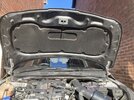

Okay, I have now done everything I need to do to complete the fitting of my carbon fibre bonnet (hood) and can reveal all the good and bad involved……
The Buying
I ordered this directly from Alibaba which, if you didn’t already know, is the source for all that is sold on AliExpress. When buying from Alibaba you are dealing directly with the manufacturer and this bring gains but also pitfalls. Sometimes there is a minimum order quantity for example, but for items like this that quantity is often just 1.
Alibaba has its own messaging service so I started by messaging the manufacturer and asked for details and more photos. Their agent (excellent English) responded with picture of the outside and underside (many other makes do not show the underside!) and also a short video. They explained that it would me made to order and I checked the price including shipping. This total price was just £700.00 - that is for the bonnet and the shipping and taxes - delivered to my door. The agent generated an invoice and I paid and received confirmation. About a week later it was shipped and I received all the shipping details - consignment number, tracking number etc.
I ordered it on the 27th of December 2025 and received it on the 17th of March 2026. It would have come a couple of weeks earlier but ships have to wait to dock in the U.K. As their is a huge backlog! All this was available to see on the tracking log.
Once it was ready for local delivery I was emailed to confirm the address and delivery date.
Next the fitting…..
The Buying
I ordered this directly from Alibaba which, if you didn’t already know, is the source for all that is sold on AliExpress. When buying from Alibaba you are dealing directly with the manufacturer and this bring gains but also pitfalls. Sometimes there is a minimum order quantity for example, but for items like this that quantity is often just 1.
Alibaba has its own messaging service so I started by messaging the manufacturer and asked for details and more photos. Their agent (excellent English) responded with picture of the outside and underside (many other makes do not show the underside!) and also a short video. They explained that it would me made to order and I checked the price including shipping. This total price was just £700.00 - that is for the bonnet and the shipping and taxes - delivered to my door. The agent generated an invoice and I paid and received confirmation. About a week later it was shipped and I received all the shipping details - consignment number, tracking number etc.
I ordered it on the 27th of December 2025 and received it on the 17th of March 2026. It would have come a couple of weeks earlier but ships have to wait to dock in the U.K. As their is a huge backlog! All this was available to see on the tracking log.
Once it was ready for local delivery I was emailed to confirm the address and delivery date.
Next the fitting…..
The Fitting
Once you’ve broken open the plywood packing case and stripped off all the foam and bubble wrap you find the bonnet with a couple of bits of wood bolted to where the hinges go and a loop and mounting plate for the bonnet catch. All the hardware supplied is stainless steel.
Threaded inserts are already in place for the hinges and for the bonnet catch so mounting these is easy and they line up with no problem.
You will need a friend to help you but just unbolt the old bonnet and bolt on the new - simple as that!
But….. it’s not all plain sailing.
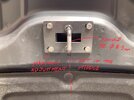
The issue is the diameter of the bar that forms the catch loop. As supplied it is 9mm in diameter but this will not fit into the catch as 8.5mm is the maximum that it will take. Luckily I was able to file it down a little and now it fits perfectly. Also, if you closely, the bonnet catch isn’t actually central to the bumper! For some reason it’s mounted about 9mm to one side. Thankfully there is just sufficient adjustment in the mounting plate (slotted holes) to allow for this. I also painted mine as I happen to have etch primer and some top coat to hand.

The next issue is with all the bits that fit under the bonnet. The hook that the bonnet prop is attached to is there but the hole in it is too small and none of the other holes exist. However, as this has clearly been moulded directly from a real bonnet (and not just scanned) you can see where all the holes should be and it’s reasonable easy to drill them if, as I do, you have a drill and a selection of drill bits. It is at this point that you find out that the underside is made of glass fibre and thick glass fibre at that. As a result, none of the clips will fit as they are for sub 1mm thick steel and not 4mm thick glass fibre. So they either have to be modified or you have to reach into the holes you have drilled with a Dremel (as I did) and sand the edges thinner. Oh, you have to make a square hole for the clip for the bonnet prop - again, I used a Dremel.
The final fit is actually very good and you really can’t complain for the price.
Once you’ve broken open the plywood packing case and stripped off all the foam and bubble wrap you find the bonnet with a couple of bits of wood bolted to where the hinges go and a loop and mounting plate for the bonnet catch. All the hardware supplied is stainless steel.
Threaded inserts are already in place for the hinges and for the bonnet catch so mounting these is easy and they line up with no problem.
You will need a friend to help you but just unbolt the old bonnet and bolt on the new - simple as that!
But….. it’s not all plain sailing.
The issue is the diameter of the bar that forms the catch loop. As supplied it is 9mm in diameter but this will not fit into the catch as 8.5mm is the maximum that it will take. Luckily I was able to file it down a little and now it fits perfectly. Also, if you closely, the bonnet catch isn’t actually central to the bumper! For some reason it’s mounted about 9mm to one side. Thankfully there is just sufficient adjustment in the mounting plate (slotted holes) to allow for this. I also painted mine as I happen to have etch primer and some top coat to hand.
The next issue is with all the bits that fit under the bonnet. The hook that the bonnet prop is attached to is there but the hole in it is too small and none of the other holes exist. However, as this has clearly been moulded directly from a real bonnet (and not just scanned) you can see where all the holes should be and it’s reasonable easy to drill them if, as I do, you have a drill and a selection of drill bits. It is at this point that you find out that the underside is made of glass fibre and thick glass fibre at that. As a result, none of the clips will fit as they are for sub 1mm thick steel and not 4mm thick glass fibre. So they either have to be modified or you have to reach into the holes you have drilled with a Dremel (as I did) and sand the edges thinner. Oh, you have to make a square hole for the clip for the bonnet prop - again, I used a Dremel.
The final fit is actually very good and you really can’t complain for the price.
To summarise the issues to watch out for:

A/ The latch hoop needs to be 8.5mm in diameter and not the 9mm it is now. Also the mounting plate needs to be set to the maximum adjustment as the latch mechanism (on the car) is not completely central.
B/ 4 bonnet stops that screw in and out for adjustment. These holes do not have to be drilled as they are moulded in, but the glass fibre is too thick for the rubber bumpers to screw in so I had to reach into the holes and sand the surrounding area from behind with a multi tool (Dremel).
C/ 2 further bonnet stabilisers. These holes had to be drilled but the rubber will just push into place and hold.
D/ 12 push in clips to hold the under bonnet pad. These holes had to be drilled but the clips will just push in and hold, same as C.
E/ The angled pivot support is already moulded into place but the hole in it is not big enough for the plastic retainer that the stock bonnet has (I lost mine whilst trying to fit it - it fell into the engine bay and I guess it’s hiding on the floor pan somewhere).
F/ The holding clip for the bonnet support rod. I had to cut a square hole for this. As with B the glass fibre is too thick and the hole is too small to be able to reach behind it so I modified the clip to work with the greater thickness of the fibre glass. I used my Dremel and a piercing bit to cut the hole.
This is not a 100% carbon fibre part. In fact I suspect it is mainly a glass fibre part with a top skin of carbon fibre. However, this is reflected in the cost and the top surface is real carbon fibre. What this means is that it’s not as light weight as a 100% carbon part would be but how much that matters is up to you - it’s still appreciably lighter than the stock bonnet.
The glass fibre varies in thickness from 2 to 5mm approximately - so it’s pretty thick in places.
This is an exact copy of the stock bonnet and the moulds have clearly been taken directly from one. Just like the stock one it is made from two parts glued together and so it is hollow. The benefit of this is that it means all the stock bonnet furniture can be used and, if you look closely, you can see where the holes need to be drilled.
How this bonnet compares to others on the market I don’t know and this is primarily because those other suppliers give very few details - certainly too few for me to be prepared to risk spending the extra money they are asking.
A/ The latch hoop needs to be 8.5mm in diameter and not the 9mm it is now. Also the mounting plate needs to be set to the maximum adjustment as the latch mechanism (on the car) is not completely central.
B/ 4 bonnet stops that screw in and out for adjustment. These holes do not have to be drilled as they are moulded in, but the glass fibre is too thick for the rubber bumpers to screw in so I had to reach into the holes and sand the surrounding area from behind with a multi tool (Dremel).
C/ 2 further bonnet stabilisers. These holes had to be drilled but the rubber will just push into place and hold.
D/ 12 push in clips to hold the under bonnet pad. These holes had to be drilled but the clips will just push in and hold, same as C.
E/ The angled pivot support is already moulded into place but the hole in it is not big enough for the plastic retainer that the stock bonnet has (I lost mine whilst trying to fit it - it fell into the engine bay and I guess it’s hiding on the floor pan somewhere).
F/ The holding clip for the bonnet support rod. I had to cut a square hole for this. As with B the glass fibre is too thick and the hole is too small to be able to reach behind it so I modified the clip to work with the greater thickness of the fibre glass. I used my Dremel and a piercing bit to cut the hole.
This is not a 100% carbon fibre part. In fact I suspect it is mainly a glass fibre part with a top skin of carbon fibre. However, this is reflected in the cost and the top surface is real carbon fibre. What this means is that it’s not as light weight as a 100% carbon part would be but how much that matters is up to you - it’s still appreciably lighter than the stock bonnet.
The glass fibre varies in thickness from 2 to 5mm approximately - so it’s pretty thick in places.
This is an exact copy of the stock bonnet and the moulds have clearly been taken directly from one. Just like the stock one it is made from two parts glued together and so it is hollow. The benefit of this is that it means all the stock bonnet furniture can be used and, if you look closely, you can see where the holes need to be drilled.
How this bonnet compares to others on the market I don’t know and this is primarily because those other suppliers give very few details - certainly too few for me to be prepared to risk spending the extra money they are asking.
Last edited:


Thank you 
 . Yes, it was a bit of a ‘leap of faith’ but I thought that if I didn’t try it I would never know. I’m astonished how little info sellers give regarding products like this. I’ve just checked the N-Garage page for their carbon fibre bonnet and they have one picture! One solitary picture and that’s just of the top surface with it fitted to a car. I can’t imagine who would risk their money on something with so little documentation. Before I ordered the Chinese one they sent me pictures of both sides and a video of it.
. Yes, it was a bit of a ‘leap of faith’ but I thought that if I didn’t try it I would never know. I’m astonished how little info sellers give regarding products like this. I’ve just checked the N-Garage page for their carbon fibre bonnet and they have one picture! One solitary picture and that’s just of the top surface with it fitted to a car. I can’t imagine who would risk their money on something with so little documentation. Before I ordered the Chinese one they sent me pictures of both sides and a video of it.
The lack of pictures, reviews, explanations on fitting (for parts custom made like RPM perf) are what often put me off massively, like you say for the price some things are you expect more information given to us the consumer
The lack of detail makes me doubt the provenance of the part. I was doing a search earlier and I found a CF bonnet for the Elantra that stated bonnet pins would be required to mount it and also a heat shield if the finish was not to be damaged! It wasn’t explained but the expectation that hood pins would be needed suggests there is no latch mechanism and/or there are no fixings for the hinges. Perhaps there is no under-bonnet reinforcing structure but as there is no explanation or picture it’s up to the buyer to guess.
My first fault!
After 3.5 years of ownership I’ve encountered my first fault. In the last couple of weeks I’ve found that when putting the car into reverse I get a sensor error and the rear parking sensors don’t work. This is a bit intermittent and in the last couple of days I haven‘t had it at all!

None of the sensors have been pushed in and I have cleaned them thoroughly many times so I guess a connection is poor, or something similar. Funnily enough, considering how many mods my car has had, the rear bumper has never been removed or modified .
.
After 3.5 years of ownership I’ve encountered my first fault. In the last couple of weeks I’ve found that when putting the car into reverse I get a sensor error and the rear parking sensors don’t work. This is a bit intermittent and in the last couple of days I haven‘t had it at all!
None of the sensors have been pushed in and I have cleaned them thoroughly many times so I guess a connection is poor, or something similar. Funnily enough, considering how many mods my car has had, the rear bumper has never been removed or modified
. (i joke)
This may be of interest - going back a year or so I reached out to Carbonetics who had started to advertise a hood/bonnet for the i20N and this seems to be the same one that N-Garage also sell. Yesterday I remembered that I did ask Carbonetics for some further details and they sent me these pictures:
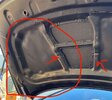


Now these are actually pictures of their i30N bonnet but they bear a striking resemblance to the one I bought - in particular the matte black sprayed finish to the underside. This bonnet has vents and the red ringed section is to show a panel that blanks off the vents underneath - stopping water ingress (and stopping the vents from doing anything). This is identical to the solution adopted by the Chinese manufacturers….. The bonnet catch looks to be bonded into place but I suspect this was not found to be sufficiently solid and has since been reinforced - just as mine is. If I look very closely at the pictures I can see the faint outline of the tape used to block off various holes in the part the pattern was taken off - this is identical to mine and I feel confident in saying this part has been made by the same people who made mine.
Now these are actually pictures of their i30N bonnet but they bear a striking resemblance to the one I bought - in particular the matte black sprayed finish to the underside. This bonnet has vents and the red ringed section is to show a panel that blanks off the vents underneath - stopping water ingress (and stopping the vents from doing anything). This is identical to the solution adopted by the Chinese manufacturers….. The bonnet catch looks to be bonded into place but I suspect this was not found to be sufficiently solid and has since been reinforced - just as mine is. If I look very closely at the pictures I can see the faint outline of the tape used to block off various holes in the part the pattern was taken off - this is identical to mine and I feel confident in saying this part has been made by the same people who made mine.
Moving on from the slightly divisive subject of carbon fibre bonnets  , I am now going to start documenting my current project which is altering my cars audio system. Some reading this may be aware that the audio has already been hugely upgraded and the system is entirely custom. The crossover between the doors mi/bass, tweeters and sub-woofer is all done by DSP which really comes into its own with car audio. Anyway, my friend Dave and I have been working on the crossover and have found the tweeter and mid/bass do not quite reach each other so there is a dip in the frequency response where the crossover point is. A German car audio brand called Helix have recently released a 2” drive unit that behaves rather like a small mid-range driver that can also play up to 20K Hz like a tweeter - so it plays significantly lower than a normal tweeter.
My tweeters are already in custom sail panels and look like this:

To fit the new drive units I’ve managed to buy replacement sail panels and I have designed rings for the new drive units to mount to - these have been 3D printed. In this next picture you can see I’ve started to construct the new housing. This will be skimmed with body filler and sanded - lots to do yet.

, I am now going to start documenting my current project which is altering my cars audio system. Some reading this may be aware that the audio has already been hugely upgraded and the system is entirely custom. The crossover between the doors mi/bass, tweeters and sub-woofer is all done by DSP which really comes into its own with car audio. Anyway, my friend Dave and I have been working on the crossover and have found the tweeter and mid/bass do not quite reach each other so there is a dip in the frequency response where the crossover point is. A German car audio brand called Helix have recently released a 2” drive unit that behaves rather like a small mid-range driver that can also play up to 20K Hz like a tweeter - so it plays significantly lower than a normal tweeter.My tweeters are already in custom sail panels and look like this:
To fit the new drive units I’ve managed to buy replacement sail panels and I have designed rings for the new drive units to mount to - these have been 3D printed. In this next picture you can see I’ve started to construct the new housing. This will be skimmed with body filler and sanded - lots to do yet.
This is the new drive unit - the Helix Ci5

 www.audiotec-fischer.de
The magnet is small because it is neodymium and not ferrite.
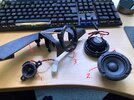
1. This is one of the stock tweeters that come in the car (non Bose).
2. The new Helix drivers with its trim ring. There is a Helix badge that I’ve removed for now.
3. The 3D printed mounting ring I drew. It has threaded inserts for the M3 machine screws that will hold in the driver.
4. The sail panel that I’ve started to cut up to allow the new driver to fit. I’ve angled the mounting ring so the drive unit will point directly at the driver. At present it’s just held in three places so I can check it’s pointing correctly.
HELIX Ci5 M50FM-S3 | Audiotec Fischer
HELIX COMPOSE i5 50 mm / 2 inch advanced wideband speaker with unique silicon coated paper cone, push-pull neodymium magnet system, high efficiency and FlexMount technology
www.audiotec-fischer.de
The magnet is small because it is neodymium and not ferrite.
1. This is one of the stock tweeters that come in the car (non Bose).
2. The new Helix drivers with its trim ring. There is a Helix badge that I’ve removed for now.
3. The 3D printed mounting ring I drew. It has threaded inserts for the M3 machine screws that will hold in the driver.
4. The sail panel that I’ve started to cut up to allow the new driver to fit. I’ve angled the mounting ring so the drive unit will point directly at the driver. At present it’s just held in three places so I can check it’s pointing correctly.
I’m going to use a laser sight (the red dot sights you get for pistols) to confirm alignment of the drive units. I’ve bought a simple and cheap one from AliExpress and am waiting on its delivery. I’ve also drawn up a mock drive unit and faceplate to hold the laser sight/pointer but I really need the pointer to check a couple of dimensions before I get the mount printed. Unfortunately this is slowing things down at this point as I can’t do anything further until the red dot arrives.



The above pictures are Ai generated from a picture I took at the supermarket - in a covered parking lot they have. It‘s a shame the picture of the car in a plain room shows the bonnet as just black but the original picture wasn’t in direct sunlight and I guess there is a limit to what can be expected from Ai .
Cabin air filters and linkages
Some time a go I read a post on a Facebook group about an HVAC linkage that can become disconnected. This is a very common problem with the i20 and is down to a minor misalignment of the two parts concerned. There is a pin that fits into a slot and as the cam the pin is attached to rotates the pin moves in the slot and adjusts the flap that directs air to your feet. If the pin were a little bit longer there would be no problem, but it’s not and so easily pops out of the slot and so the flap no longer adjusts. It’s rather awkward to do but you can pop the pin back into the slot but it just happens again. I checked on it yesterday and, sure enough, the pin had popped out again. So I’m thinking of drilling the pin with a 2 or 3mm hole and fitting a bolt with a couple of washers to hold the pin and slot loosely together - even a small cable tie would be enough. This would be an easy job if access was a little bit better but the HVAC system and associated cabin filter block access. I tried yesterday with a pin vice and drilling by hand but just couldn’t get my fingers in there enough. I’ve got a right angled head for my Dremel and will see if there is room for that but I have my doubts.
As part of these investigations I removed the cabin air filter - a simple corrugated paper affair. I gave it a clean but thought it could usefully be replaced. When I looked into which part to get I found that K&N do ‘lifetime’ versions that can be washed! But instead I’ve bought a fancy Bosch one - hopefully it fits or it’s going straight back .
.
Update:
After much messing about I’ve managed to fix the linkage issue - I think! Now you’ve got to take into account that I have a huge amount of ‘stuff’ so I looked through all my M3 machine screws and found some the right length, some washers and some nuts. I also found a packet of very thin cable ties. As I was thinking about it all I also remembered that I have a cordless pin vice - it’s only some 15mm in diameter so good for narrow spaces. So I removed the glove box and tried again. With a bit of fiddling and the use of a head torch, I managed to drill a 2.4mm hole in the locating pin. It’s just way too tight in there to get a nut and bolt in there so I resorted to threading the cable tie through the hole in the pin and the slot and loosely tied them together. This was only possible because I also had a pair of long nose pliers! Time will tell….
This was extremely fiddly and tricky to do and I used a number of tools people are unlikely to own!. If I could have removed the frame structure that is infront of the HVAC system it would have been vastly easier but I couldn’t see any way to do that. Of course I could have let Hyundai try to solve this as my car is still under warranty but I didn’t want them to start disassembling the whole dash and potentially introducing problems where none currently exist.
.Cabin air filters and linkages
Some time a go I read a post on a Facebook group about an HVAC linkage that can become disconnected. This is a very common problem with the i20 and is down to a minor misalignment of the two parts concerned. There is a pin that fits into a slot and as the cam the pin is attached to rotates the pin moves in the slot and adjusts the flap that directs air to your feet. If the pin were a little bit longer there would be no problem, but it’s not and so easily pops out of the slot and so the flap no longer adjusts. It’s rather awkward to do but you can pop the pin back into the slot but it just happens again. I checked on it yesterday and, sure enough, the pin had popped out again. So I’m thinking of drilling the pin with a 2 or 3mm hole and fitting a bolt with a couple of washers to hold the pin and slot loosely together - even a small cable tie would be enough. This would be an easy job if access was a little bit better but the HVAC system and associated cabin filter block access. I tried yesterday with a pin vice and drilling by hand but just couldn’t get my fingers in there enough. I’ve got a right angled head for my Dremel and will see if there is room for that but I have my doubts.
As part of these investigations I removed the cabin air filter - a simple corrugated paper affair. I gave it a clean but thought it could usefully be replaced. When I looked into which part to get I found that K&N do ‘lifetime’ versions that can be washed! But instead I’ve bought a fancy Bosch one - hopefully it fits or it’s going straight back
.Update:
After much messing about I’ve managed to fix the linkage issue - I think! Now you’ve got to take into account that I have a huge amount of ‘stuff’ so I looked through all my M3 machine screws and found some the right length, some washers and some nuts. I also found a packet of very thin cable ties. As I was thinking about it all I also remembered that I have a cordless pin vice - it’s only some 15mm in diameter so good for narrow spaces. So I removed the glove box and tried again. With a bit of fiddling and the use of a head torch, I managed to drill a 2.4mm hole in the locating pin. It’s just way too tight in there to get a nut and bolt in there so I resorted to threading the cable tie through the hole in the pin and the slot and loosely tied them together. This was only possible because I also had a pair of long nose pliers! Time will tell….
This was extremely fiddly and tricky to do and I used a number of tools people are unlikely to own!. If I could have removed the frame structure that is infront of the HVAC system it would have been vastly easier but I couldn’t see any way to do that. Of course I could have let Hyundai try to solve this as my car is still under warranty but I didn’t want them to start disassembling the whole dash and potentially introducing problems where none currently exist.
Last edited: